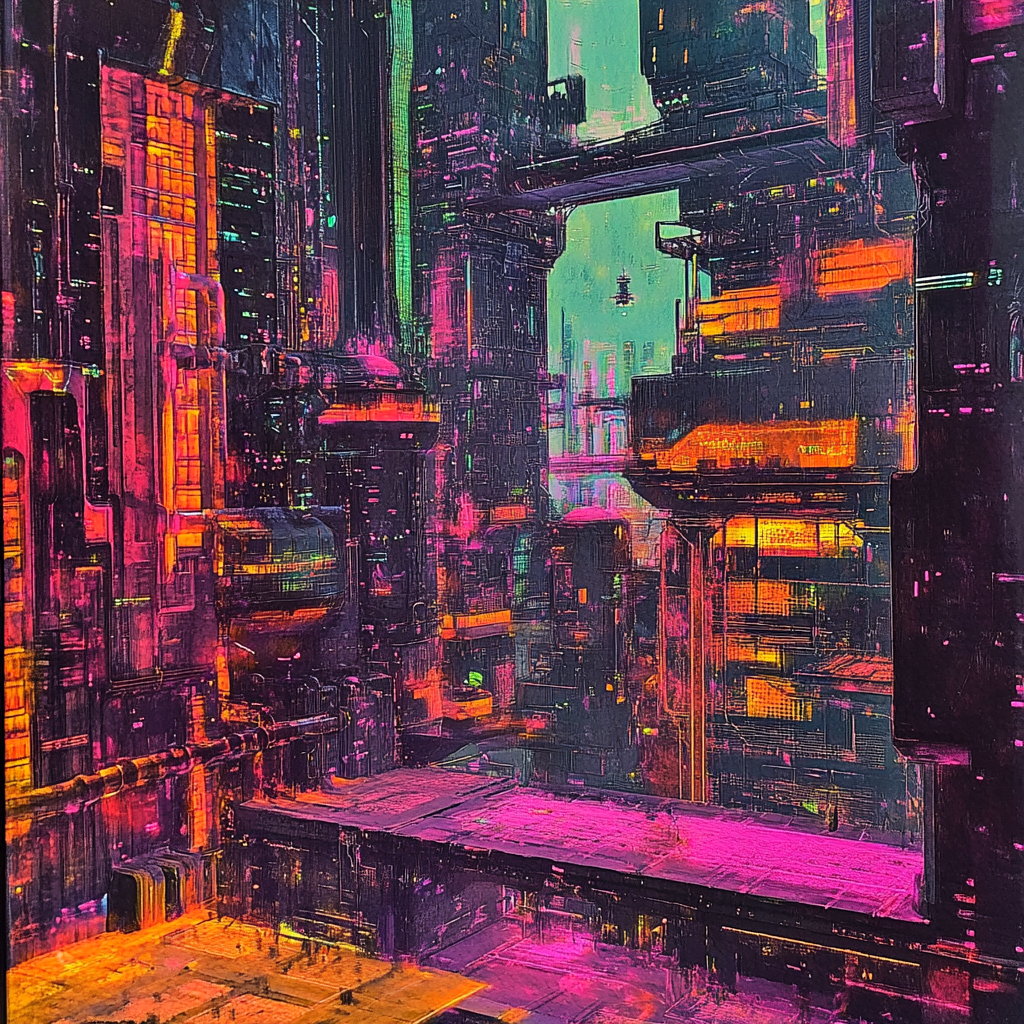
CHAPTER 1
The outskirts of District 7 always felt colder after midnight. Neon bled through cracks in the pavement, casting bruised light on the faces that drifted past, heads down, feet wet, everyone pretending not to notice anyone else. The air tasted of rust and old rain.
John Hungerman leaned, thumb moving over his device out of habit, not hope. His hands looked like they’d lost too many fights, knuckles swollen, nails chewed to the quick, skin rough as concrete. If the city could sandpaper a man down to just muscle memory and debt, John was the proof.
“Couldn’t sleep, eh?” he said. The words dropped flat between them, barely more than a puff of breath.
“No,” Betty said. She pulled her coat tighter, more out of reflex than warmth. Gray streaked her hair like she’d earned every shade; lines mapped years across her face, but she wore them with a kind of stubborn dignity. The city had taken plenty, but she was still here. That was something.
John scrolled through the news feed, the blue light making his scars look deeper. “Resistance hit the District 7 capital again. That’s the third time this month. Maybe they’ll get it right eventually.”
Betty grunted. “Feels like it’s been going on since before we were born. I’m starting to think nobody’s actually running this place.”
“They keep adding charges to every damn subscription. New rep hasn’t lifted a finger, but somehow he’s got a new car.” John shook his head, not angry, just tired.
“They never do,” Betty said, voice flat. She stared up into the haze, as if searching for the stars. All she found was more neon, and the low clouds swallowed the city whole out in the distance.
John paused, thumb hovering. “Thought about switching to Plan Optimal. Maybe if I pay enough, the world stops falling apart for a week.”
Betty snorted, a sound halfway to laughter. “We already owe more credits than we’ll ever see. Might as well ask them to start billing us for the air.”
He almost smiled. “Maybe next month. Gotta keep us guessing.”
She shifted her weight, a small shiver running through her. “You ever think about just letting the resistance win? At least then something would change.”
John gave a dry chuckle. “Change? Last time anything really changed, I lost three fingers and a pension.” He held up his hand like proof, the missing tips flashing under the night sky. “Anarchy’s just another word for gang violence and crime sprees .”
“Maybe. Still, this isn’t much of a life,” Betty murmured. Her breath hung in the cold, disappearing before it meant anything.
A car came barreling through, engine screaming, spraying gutter water across John’s boots as it cut the corner close. He didn’t flinch, just glared after it.
“Bloody bastards,” he called, but even he knew it didn’t matter.
They stood there in the silent aftermath, their breath steaming, city noise washing over them, two more ghosts holding out against the night, for no reason they could name.
CHAPTER 2
Inside the car, city lights strobed across the windshield, glancing off Ginger’s hands as he pressed them to the cold glass. The air reeked of engine oil, old takeout, and a whiff of air freshener that never covered the truth.
The driver kept his eyes ahead, not part of this conversation.
In the back, Ginger and Plain rode together, both men worn thin, but in different ways. Ginger’s dreads caught what little light there was, beard gone more gray than black now. Plain could have vanished into any crowd, neat haircut, tidy shirt, quiet eyes always working out angles.
Ginger spoke first, voice low. “You ever notice how the city always finds a way to squeeze you, no matter how much you try to stay ahead? We’re close to tapped out, Plain. If this keeps up, all we built…Gone.”
Plain didn’t bother turning. “We can hold on. We’ve got “him” now. Outsiders bring a little breathing room, maybe even attention from outside. That’s leverage.”
Ginger’s mouth twitched. “Leverage is just a fancier word for debt, where I’m from. You think any outsider ever saves us? Megacity’s seen rebellions come and go, brother. Closest anyone ever got, the corporations wrote a check and called it progress.”
Plain’s reply was steady, as ever. “This time the corps are eating each other. They’re softer than they look. If we pick our spot, we don’t have to be the ones selling out.”
Ginger stared at the dark blur of city through the glass. “I’ve watched too many men lose everything thinking they had the upper hand. The house always finds a way to win. Maybe you run hot for a while, but in the end, you’re out on the curb with empty pockets.”
Plain’s answer was quiet. “This isn’t a casino. We’re not gambling, we’re planning. We play them against each other, wait for the right moment, then move.”
Ginger snorted, almost a laugh. “You’re always thinking it’s a game you can beat. But you sit in the backroom long enough, you see it’s always the same faces cashing out.”
Plain watched the city blur past, the lights flickering in his eyes. “It’s not about beating them. It’s about not folding too soon. If the corps think they’ve got us desperate, they’ll pick us off, buy us out one at a time.”
“So we just wait?” Ginger asked, voice low.
“We watch,” Plain replied. “We push them when it’s safe, pull back when it isn’t. We keep them guessing. Let them think they’re holding all the cards, until we find the crack. Timing is everything.”
Ginger ran a thumb over the old chip in his hand, thoughtful. “You’re saying we bait the hook, but don’t reel anything in till they’re already tangled.”
Plain nodded. “Exactly. Show too much, too soon, they’ll play us against ourselves. We move when it hurts them most, never before.”
Ginger looked over, gave a slow, grudging smile. “And if we get played?”
Plain met his gaze, calm as ever. “Then we get played. But not for free. Make it cost them something real.”
Ginger let out a breath, watching the night roll by. “We’ll let the council know.”
Neither man said another word. The city, as always, kept its secrets.
CHAPTER 3
The old apartment complex sat far from Megacity’s glittering center, tucked behind overgrown lots where weeds and wild grass had reclaimed what the planners forgot. A few stubborn trees leaned into the wind, patches of green pushing up through cracked pavement, a hollow paradise for the forgotten, hidden in the sprawl of District 5.
The building looked like any other crumbling block: peeling paint, broken window screens, flickering hallway lights. People drifted through, routines stitched together by habit and necessity. Out front, locals smoked on the stoop, voices low, laughter too quick, cover for whatever they really thought about strangers.
Elvin hovered near the entrance, fidgeting with a battered comms device. When a shadow separated itself from the sidewalk, Elvin tensed, ready.
“Hey, are you the one heading to LL Corp?”
Elvin straightened, measuring. “Yeah?”
“Codename Elvin, right?”
“That’s me. What’s this about?”
“Change of plans,” the man said, calm as weather. “I’m to go in your stead.”
Elvin’s relief flickered, but he didn’t let his guard drop. “Didn’t hear about any update. Who gave the order?”
“Commander Elroy had a talk with the master. Figured it was better if one of the outsiders took this one.”
Elvin scanned the street, patches of grass, night stretching on. “All right. Good luck, then.”
“Thanks.”
Kenan started to leave, but Elvin reached into his pocket, holding out a capsule. “Might need this. Just in case.”
Kenan eyed it for a moment, then smiled. “That’s all right. I’d rather not draw more attention than I already do.”
“Suit yourself.”
Kenan nodded and slipped away, his silhouette swallowed by the wild edges of District 5. Elvin watched until the street was empty again.
CHAPTER 4
The lobby of the Argus Tower was made of angles and cold light. Steel ribs ran along the walls like the bones of some great machine. Glass panels stretched high above, catching artificial sunlight in unnatural ways. Everything gleamed too clean, smelled too sterile like nothing had ever really lived here.
Two receptionists sat behind a black marble desk that curved like a blade. They wore matching blazers and mirrored expressions, exhausted, caffeinated, barely hiding their contempt for the job. Behind them stood two androids in synthetic suits, too tall, too symmetrical. Their smiles didn’t reach their eyes.
Then the doors parted, and a man stepped through.
His coat looked like it had crossed continents. Worn canvas streaked with salt and dust, patched in places where time had gotten the better of thread. His boots were caked with dried mud —not the kind found in Megacity, but the kind from places people here had only seen in filtered images. No badge, no implant, no corporate mark. Just a quiet calm, and a presence that didn’t quite make sense.
He walked up to the desk slowly, as if trying not to wake the building.
“Good morning,” he said, his voice low, accent soft but unfamiliar. “I’m here to speak with the Headmaster.”
The woman behind the desk looked up, scanning him like a barcode. “Do you have an appointment, sir?”
He blinked, hesitated. “Not exactly. I was sent. From the resistance.”
That got her attention but only just. She tapped the screen in front of her with slow, deliberate fingers.
“I’ll need your ID. And confirmation of the meeting.”
He shifted his weight. “I’m just a messenger. It was arranged through… intermediaries.”
“Name?”
He paused again. Thought about lying, then realized he didn’t have one ready. “Just… the messenger. There’s a code word. Panda.”
Her eyebrows twitched. “Panda.”
“Yes.”
There was a silence that felt heavier than it should have.
“Sir,” she said, with strained professionalism, “I can’t move this forward without proper authorization. You can leave a contact reference or-”
“Look,” he said gently, “just tell the Headmaster someone’s here about Panda. I think he’ll want to hear what I have to say.”
She sighed and exchanged a glance with her colleague, who shrugged. She gestured toward the chrome bench against the far wall. “Take a seat.”
“Thank you,” he said, and did as told.
He sat upright, hands resting on his knees, eyes scanning the space, not with paranoia, but with curiosity. It was like walking through someone else’s dream. Everything too tall. Too cold. Too bright. It didn’t threaten him, not really. But it was… unnatural. A sort of theater built to keep people small.
A man in a gray suit appeared near the far door, speaking into an earpiece. One of his eyes had been replaced, clean tech, expensive, the kind that let you scan micro-expressions and heartbeat patterns. The man looked over at the stranger, frowned, and said something quietly.
Another agent came forward, holding a scanning device. He didn’t speak.
The messenger stood, arms slightly raised. “Of course.”
The scanner blinked red, then green. They weren’t sure what they were looking for, but whatever it was, he wasn’t it.
The first man sat down across from him.
“State your business.”
“I already did,” he said simply. “I’m the messenger. From the resistance. About Panda.”
The man watched him in silence, the mechanical eye whirring faintly.
More time passed. A second suit joined the first. Then a third. They spoke in hushed tones by the reception desk, their voices tight. The androids hadn’t moved. The receptionist sipped her coffee but didn’t look up again.
The messenger remained still.
Eventually, the first suit returned. “Come with me.”
He rose slowly, “Lead the way.”
They moved through polished corridors that gleamed like hospital floors. Everything here was made to disorient. Lights without shadows. No markers. No clocks. But the messenger took in every turn, every hallway, every corner, cataloguing. An old habit. Dangerous places had patterns.
They passed glass doors, sealed rooms, quiet surveillance.
The deeper they went, the quieter it got.
The man guiding him didn’t speak, and the messenger didn’t press. He was already building a map. He could feel the weight of this place, how the walls listened, how the doors were built to close fast and hard.
He smiled faintly.
This wasn’t what he expected.
But that’s why he came.
CHAPTER 5
The room was too clean to feel safe. Fluorescent light hummed faintly from a recessed panel overhead, casting everything in that sickly blue corporate tint. The walls were seamless gray, undecorated, somewhere between a medical suite and an interrogation chamber. No windows. Just a mirror that didn’t quite reflect the world right.
A single metal chair waited in the center.
The messenger walked in calmly, eyes glancing over the mirror, then the two men flanking him. One broad with the stiffness of someone used to throwing people through walls. The other wiry, with a face like a closed fist.
He took the chair, draped his worn coat over the back like he was settling in at a friend’s kitchen table. The two men didn’t sit.
“So,” the wiry one said, arms crossed. “You want to explain what you’re doing here?”
“I told your colleagues at the front,” the messenger replied gently. “I need to speak with the Headmaster. It concerns the resistance.”
The heavy-set man let out a breath that was halfway to a scoff. “You think you can just walk in here, no badge, no retinal scan, no clearance and what? Grab lunch with the head of Argus?”
The messenger tilted his head, almost apologetically. “I thought… well, where I’m from, if you need to speak with someone in charge, you ask. I didn’t realize how… many doors there are here.”
That pause, how many doors landed with a quiet weight neither guard expected.
The two exchanged a look. His accent was unmistakably foreign, and his confusion read as real. But his stillness was unsettling. He didn’t shift in his seat. Didn’t fidget. Just watched.
The wiry one leaned in. “Listen. Whatever game you’re playing, this isn’t the place for it. People disappear in this city. No cameras, no records. Just gone.”
The messenger’s expression didn’t change. But the room felt colder.
“I wouldn’t recommend that approach,” he said softly.
Silence. The broad one adjusted his stance.
“I’m here to deliver a message. The code word is Panda. That should mean something to someone.”
The broad guy’s eyebrows tightened. “Panda?”
The messenger nodded. “I was told it would get me a meeting. I’m… not entirely sure why.”
It was so direct, so strange, so unguarded that neither guard knew what to do with it.
The wiry one muttered something into his sleeve. Static crackled. The messenger sat still as stone, hands folded in his lap.
The silence dragged. The kind of silence that makes rooms feel smaller.
Eventually the door clicked open. A third man stepped in, older, lean, dressed in something that didn’t wrinkle. The kind of man who didn’t get questioned much.
He studied the messenger for all of two seconds before turning to the others.
“What is this?”
“Says he has business with the Headmaster. From the resistance. Keeps repeating a code word. Panda.”
The newcomer’s eyes flicked. Barely. But it was enough.
He checked a slim tablet on his wrist, swiping through secured messages. A faint exhale escaped his nose.
“You brought him to the wrong building,” he said, flat.
The guards stiffened. “Sir?”
“He’s supposed to be in Building C.”
The messenger blinked. “There’s more than one building?”
The older man gave him a long look. “Easy mistake. All these towers look the same if you’re not from around here.”
He gestured vaguely at the weatherworn coat and mud-dusted boots.
The messenger nodded solemnly. “They really do.”
CHAPTER 6
The elevator’s transparent walls offered a dizzying view of Megacity’s vertical sprawl, all mirrored towers and blinking drones. But the messenger kept his gaze on the ascending numbers, rising in silence among five suited men who formed a living wall around him.
The lift stopped not at the top, but midway up the tower, where classified departments and unspeakable budgets lived. The doors opened with a hiss, revealing a corridor paneled in matte-black alloy. Gold lettering shimmered without light: DEPARTMENT OF CRISIS & CONFLICT MANAGEMENT.
Inside, the design changed. Monitors lined the walls, displaying surveillance feeds from across the city, riots in District 9, a drone convoy in District 3, a flickering thermal signature in a subway shaft. The air smelled of burnt circuitry and bitter coffee. Kenan’s eyes moved over everything, quietly registering threats and exit points. This wasn’t an office. This was a war room.
They led him to the Director’s chamber: compact, calculated, and stripped of ego. A simple desk, a single monitor. Behind it sat a man in a charcoal suit, expression smooth as glass. His nameplate read: Khan Kermit, Interim Director.
“This is… modest,” the messenger said, taking it in. “Where I come from, those in power like to show it.”
Kermit offered a dry, practiced smile. “Ostentation doesn’t scale well. I’m Khan Kermit. I understand you’ve got a message.”
Kenan stepped forward. “I assume you are the headmaster?”
Kermit said. “No. I’m the Interim Director. The Headmaster doesn’t meet just anyone.”
“I need to speak with the Headmaster. Directly.”
“That’s not how this works,” Kermit replied, tone clipped. “All information is filtered through protocol. If it matters, it moves up.”
Kenan nodded slowly. “Yes. Protocol. I’ve heard about that.”
“Then you understand.”
“I understand delays,” Kenan said. “And I understand consequences when the wrong person stalls the right information.”
Kermit’s fingers paused on the desk.
“What kind of information?”
“The kind that requires no paper trail. No digital footprint. The kind your superiors requested face-to-face.”
Kermit blinked.
“You do know about the arrangement… don’t you?” Kenan asked.
“I-of course I-”
“Because if you don’t,” the messenger continued, voice still calm, “then it sounds like there’s been a failure in your chain of trust. And in structures like this one, I assume failures don’t usually get promoted.”
Silence. Just the faint hum of the wall-mounted fans and the tick of Kermit’s secured comms.
“You’re bluffing,” Kermit said.
“Possibly,” Kenan replied. “But it doesn’t really matter, does it? Because now you have a decision.”
Kermit leaned forward, voice hardening. “You’re threatening me.”
“I’m giving you an option,” Kenan said. “You can be the one who opened the right door at the right moment, or the reason it all burned slower.”
The room tightened, air thickening with silent calculus.
Kermit’s jaw clenched. “Even if I wanted to help, the Headmaster’s schedule is sealed. Layers of security–”
“Khan,” the messenger said gently, “you didn’t get here by following every rule. You got it by knowing which ones were real, and which ones were convenient.”
Kermit said nothing.
Kenan leaned back, folding his hands. “So. What kind of Director are you?”
The pause stretched. Then Kermit reached for the secure phone.
“I’ll make some calls,” he muttered.
Kenan gave a small nod, like a man confirming a chess move.
“I’ll wait.”
CHAPTER 7:
The elevator opened with a whisper.
What lay beyond was not a boardroom, not a war room, not even a throne room but something stranger, older. A cavernous space wrapped in sleek obsidian walls and high glass panes that overlooked the city like the eye of a god. Modern surfaces shimmered under warm-toned lights, but it was the contrast that lingered: the ancient textures, cracked stone pedestals, dusted artifacts, oil paintings too large and too dark for comfort. The air smelled faintly of polished steel and aged parchment.
The room had the shape of wealth, but not the kind you could count in credits. This was curated power mythic and corporate, intertwined.
At the far end of the chamber, a desk. Plain, unimposing, surrounded by open floor as if nothing dared come too close. Behind it, the Headmaster sat not just the CEO of LL Corp, but the face of a machine so vast it didn’t need to announce itself.
And above his head, half-concealed in the backdrop of oil and shadow, a sigil curled into the brushwork of a forgotten painting. A circle, bisected. Faint claw-marks. Watchful geometry. The kind of symbol your eyes tried not to see. The kind you only recognized later, in dreams.
Kenan didn’t stare at it. Didn’t need to. His senses brushed against the room the way his fingers might graze the surface of a blade.
The Headmaster leaned back in his chair, eyes glinting with something close to amusement.
“I have to respect your initiative. Not many make it through a dozen layers of security just for a face-to-face.”
Kenan smiled. No warmth.
“And I can’t say I respect your bureaucracy. If I’d left it up to your systems, I’d still be spinning in circles in your lobby.”
The Headmaster gave a slow nod, chin lifted.
“Without my systems, I have no way to weigh the worth of your message or the man delivering it.”
Kenan’s voice cooled.
“Our cause is against those very systems. Your rules, your walls, all designed to keep power locked behind closed doors.”
“I’m well aware of your crusade,” the Headmaster said, almost bored.
“You take and take,” Kenan said, “until there’s nothing left. Until people stop being people. Until they’re either fighting or fading.”
A flicker of something crossed the Headmaster’s face, irritation? amusement?
“I hope you didn’t come just to moralize. Sermons don’t buy much in Megacity.”
Kenan stepped closer, calm, unflinching.
“If you’d ever lived like them. If you’d seen what your empire makes of people, you might think differently.”
The Headmaster’s eyes sharpened.
“Only the strong survive here. You don’t have to crawl in the dirt to know that this city is the strongest thing on earth.”
“Tell me,” he went on, tone softening to something colder, “are you prepared to go to war with us? Because your presence here… it puts your entire country in jeopardy.”
Kenan tilted his head, brows faintly drawn. The question felt… irrelevant.
“I’m not here on behalf of any nation. You won’t get a war out of this.”
The Headmaster studied him now with real interest.
“You’re not just a messenger. No accent, coat, or odd mannerisms can hide you from my systems. You don’t wear a title, but you carry one.”
Kenan let out a quiet, knowing laugh.
“You wouldn’t start a war over one man. And even if you did, my country wouldn’t bleed for my corpse.”
“What you represent,” the Headmaster said, “goes beyond that. You’re not like the rebels. You’ve tasted something deeper. You’ve walked with things most men deny exist.”
Kenan’s expression darkened. He said nothing.
“Is it really humanitarianism that brought you here, Master Kenan?” The name dropped like a quiet bomb. “Or was it boredom? That aching curiosity we all suffer from the hunger for something other?”
Kenan didn’t answer. The old instincts told him: he wasn’t the only one in this room who had seen gods.
“You’ve come to fight a machine,” the Headmaster said. “But Megacity doesn’t break under conflict. It thrives on it. You think we fear the resistance? Rebels feed the city. The smart ones get absorbed. The rest? Background noise.”
Kenan’s reply was dry, measured.
“That’s very generous of you. But you must know. I don’t care for your kind of rulers.”
The Headmaster’s eyes flicked briefly to the hidden painting behind him, then back.
“Take me out, and another will rise. But you. You’re worth more than your entire rebellion. Your presence alone… it shifts balances. I don’t know if that makes you dangerous, or useful.”
He leaned forward.
“I’ll be blunt. I see opportunity. That’s why I’m offering you something no one else gets.”
Kenan didn’t flinch.
“I came as a messenger. Nothing more. I know how this city works. You cut off the voices that speak too loud, and buy off the ones that whisper in your favor.”
The Headmaster grinned, teeth too white in the low light.
“Everyone has a price. Or a breaking point. And if they don’t. Then it becomes about experience.”
Kenan raised an eyebrow.
“Experience?”
The Headmaster rose from his chair. Behind him, the painting shifted slightly in the air, as if it breathed.
“Yes. Consider this one… a sample. Just a taste of what Megacity offers.”
Outside the door, footsteps. The hum of augments. Metal against marble.
A column of cybernetic enforcers lined the hallwaylimbs grafted, eyes gleaming. Built not for justice, but spectacle.
Kenan stayed still.
“And if I refuse?”
The Headmaster smiled wider.
“Then death, Master Kenan. It’s what makes life interesting.”
The lights dimmed. The sigil pulsed once, faint and unseen.
And the silence before violence thickened.
 Beyond The Page